



Deploy a New ERP and Train Your Teams Without Disrupting Your Business
How to effectively train your employees on a new ERP system in 2026 (without taking up entire days).
Training employees on a new ERP system is often seen as a necessary but time-consuming, costly, and sometimes frustrating process for both teams and managers. However, in 2026, expectations have changed significantly. Employees demand efficiency, practicality, and, above all, training that is integrated into their daily work.
So how can you quickly improve your teams' skills without disrupting their schedules or your business? What if the ERP itself became part of the solution?
What employees really want
Employees, whether they work in the field or in support roles, no longer want top-down, standardized, theoretical training. What they want is:
- Practical training that is directly related to their tasks
- Short formats that are available on demand
- Resources that are integrated into their business tools and accessible at the click of a button
- A gradual increase in skills, without mental overload
In other words, they want to learn by doing. And that requires a change in attitude on the part of companies, but also in the tools they use.
What is still holding companies back
In terms of organization, intentions are good, but operational reality quickly catches up with ambitions:
- Schedules are too tight to free up entire days
- Training content is often too generic
- Tools are perceived as complex and unintuitive
- Capitalization on internal knowledge is rarely structured
In this context, the implementation of a new ERP system can quickly become a source of tension and blockages if training is not approached differently.
ERP as an integrated training tool
A well-designed ERP system can play a central role in improving user skills. It is not just a matter of centralizing data or managing activity, but also of supporting employees in mastering their work tools.
Here is what a user-oriented ERP system can do:
- Visual flowcharts that explain the steps in a process
- Information bubbles integrated into business pages
- Contextual alerts that warn of errors
- Standard procedures and examples integrated into the interface;Clear, readable, intuitive ergonomics
Training thus becomes part of everyday life. No need to read a 40-page manual: the tool provides continuous training when the user needs it.
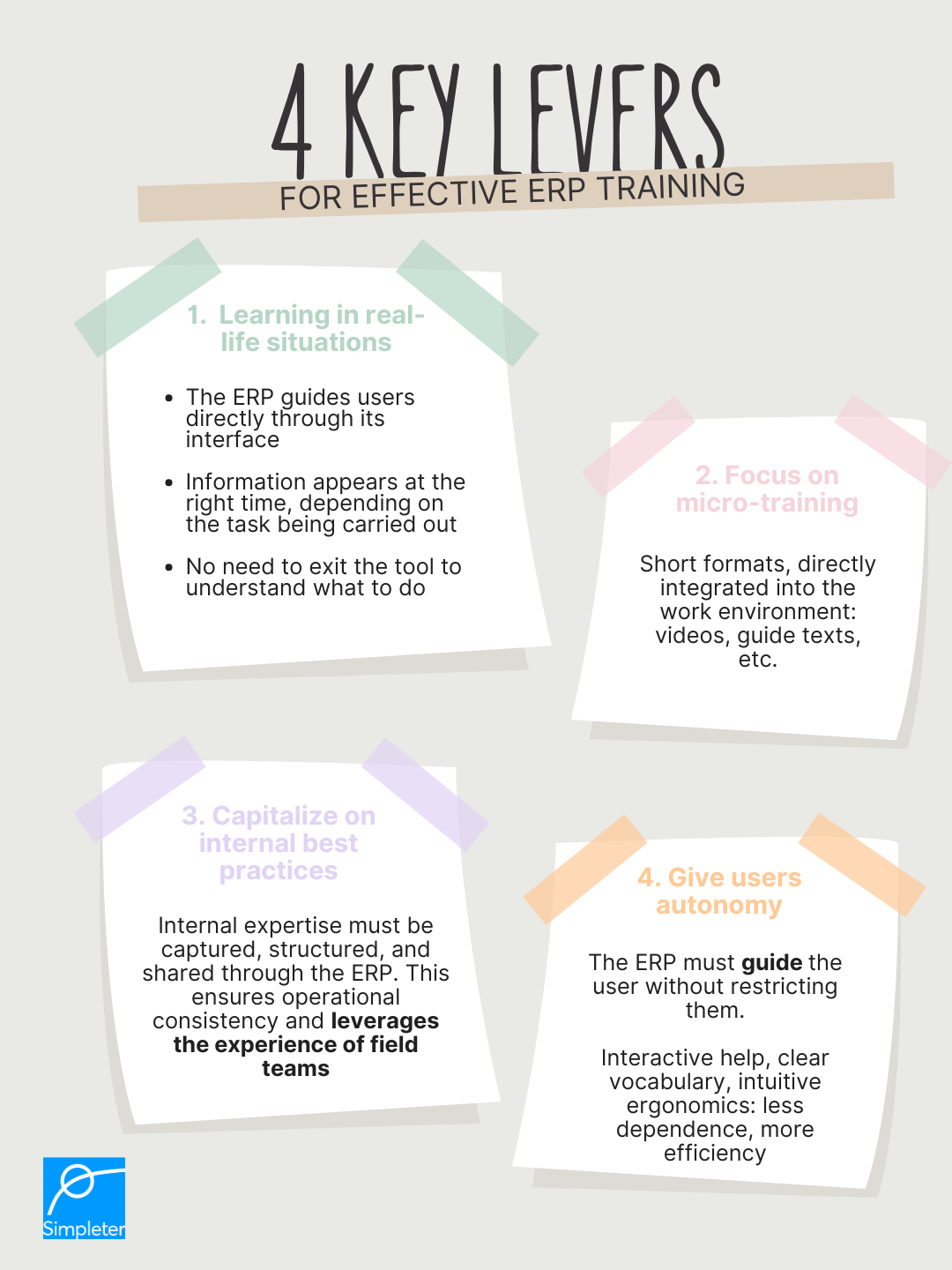
The four levers of effective ERP training
1. Learning in real-life situations
Training is much more effective when it is provided at the moment the user needs it. The ERP system must provide the right information, directly in the interface, in relation to the action being performed.
2. Focus on short formats
Tutorials, practical guides, and templates integrated into the tool allow users to progress without interrupting their work. These short formats fit naturally into everyday work.
3. Share best practices within the company
Internal expertise must be captured, structured, and shared through the ERP system. This ensures operational consistency and leverages the experience of field teams.
4. Promoting user autonomy
A clear, intuitive, and well-documented ERP system allows everyone to move forward with confidence. Interactive help, understandable vocabulary, and smooth ergonomics: users become active participants in their own skill development.
Training is no longer a cost: it is a strategic investment
By integrating training into the business tool, companies win on all fronts: fewer bottlenecks, fewer errors, faster adoption, better quality of work, and more relaxed teams.
A well-designed ERP does more than just manage the business. It supports the transformation of practices, promotes skills development, and strengthens the corporate culture.
Training is no longer a burden to be planned. It becomes an integrated, discreet, and permanent reflex.
The latest news & updates from Simpleter.





Subscribe to our newsletter
Subscribe to our monthly newsletter and keep up to date with our latest news.